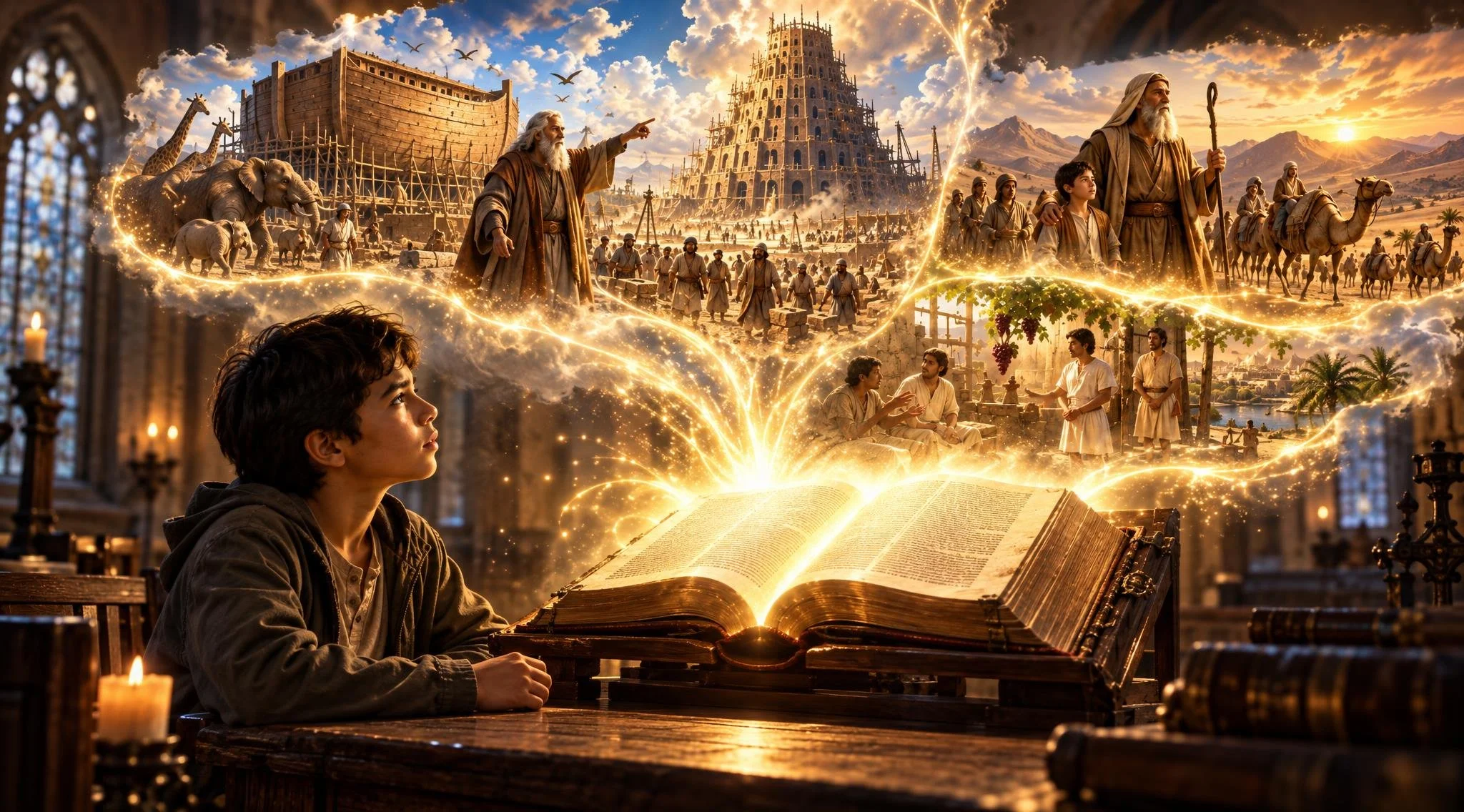
The Bible is where the stories live. Through Verbum Aeternum, Mateo steps into their world.
I receive quite a bit of correspondence about my Mateo and the Secrets of the Eternal Word series. Occasionally, someone asks a question that goes right to the heart of the story.
“Why did you choose a Bible, Verbum Aeternum, to carry Mateo thousands of years into biblical history?”
My answer is really quite simple.
The Bible is where the stories live. Only the Bible could take Mateo there.
When I began imagining Mateo's adventures, I wasn't looking for a clever way to send a twelve-year-old boy traveling through time.
I wanted him to experience the events he had been reading about in Scripture.
I wanted him to stand beside Noah as the enormous Ark took shape. To witness the confusion at the Tower of Babel. To travel with Abraham's caravan and discover what life might have been like for the people whose names we know from Genesis.
A time machine might have taken him into the past. A mysterious doorway might have led him into another world.
But neither would have had the connection I wanted between Mateo's questions and the Word of God.
That connection became Verbum Aeternum—the Eternal Word.
Of course, Verbum is a fictional creation. There isn't a Bible that can physically transport someone thousands of years into the past.
But there is something remarkable about opening the Bible and allowing its words to capture our imagination.
We read about people who lived long ago. We discover their struggles, their mistakes, their courage, and their faith.
And sometimes we begin wondering what it would have been like to stand beside them.
That's what I wanted for Mateo.
Verbum doesn't simply give him a history lesson. It places him where he can observe, listen, ask questions, and begin to understand.
And it doesn't always take him where he expects to go.
Sometimes Mateo has a question about something happening in his own life, and Verbum responds by carrying him to a biblical event that helps him see things differently.
The answers aren't always handed to him. Often, he has to discover them for himself.
There's another important part of this arrangement.
Mateo doesn't change biblical history.
He may meet the people, share their meals, travel alongside them, and even become their friend. But the events recorded in Scripture remain as they were.
I'm writing historical fiction around the biblical accounts, not rewriting the Bible.
And that brings me back to the original question.
Why a Bible?
Because the adventures of Mateo were never meant to be simply about traveling through time.
They were meant to bring the stories of Scripture to life in the imagination of a young boy—and, I hope, in the imaginations of those who read about him.
The Bible is where the stories live.
Verbum Aeternum simply opens the door.
