Who Is Verbum Aeternum?
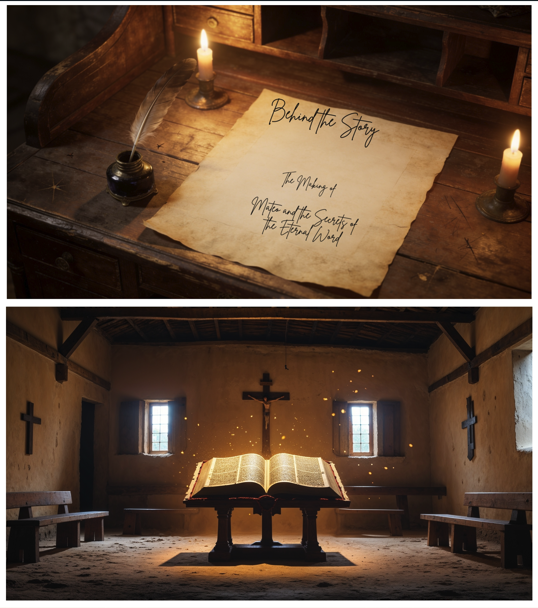
When I began writing Mateo and the Secrets of the Eternal Word, I knew I had a problem to solve.
I wanted Mateo to experience the great stories of the Bible.
Not simply read about them.
Not dream about them.
Experience them.
He needed to stand in the Garden of Eden.
He needed to hear the rain fall on Noah's Ark.
He needed to walk among the people building the Tower of Babel.
Somehow, a twelve-year-old boy living in the mountains of Nicaragua had to cross thousands of years of history.
I needed a doorway.
That doorway became Verbum Aeternum.
The Eternal Word
Verbum Aeternum is Latin.
It means The Eternal Word.
In Mateo's world, it is an enormous, ancient Bible resting inside an abandoned church in the mountains near his home.
Father Tomás watches over it.
Doña Rosa knows about it.
And somehow, both of them seem to understand far more about the book than Mateo does.
But Verbum Aeternum is not simply an old Bible.
Mateo discovers that when he asks a question.
Not just any question.
A question Verbum seems to have been waiting for Mateo to ask.
And when he finally asks it, everything changes.
The church disappears.
The mountains of Nicaragua disappear.
And when the world becomes clear again, Mateo is somewhere—and sometime—else.
The words of Scripture are no longer words on a page.
They are happening around him.
Where Did Verbum Come From?
Once I created Verbum Aeternum, another question appeared.
How could such a book exist?
I didn't want it simply to appear in an old church without a history of its own.
If Verbum had been waiting there for Mateo, then someone had to place it there.
Someone had to protect it.
And long before Mateo was born, someone had to create it.
That question eventually became a story of its own.
I began imagining another time, another place, and people who understood that the book they were creating was unlike any other.
A book meant to survive.
A book meant to be guarded.
A book meant to wait.
Exactly what happened during those years—and how Verbum eventually found its way to a forgotten church in the mountains of Nicaragua—is part of the mystery that surrounds it.
Some secrets are better revealed slowly.
A Book That Chooses?
At first, Mateo might believe his journeys simply happen to him.
But gradually, it becomes difficult to believe there is anything accidental about them.
Mateo cannot simply open the book and decide where he wants to go.
In the beginning, it starts with a question.
And from the beginning, there is the unsettling sense that Verbum already knew the question was coming.
Perhaps it had been waiting for it.
Perhaps it had been waiting for Mateo.
Father Tomás doesn't seem surprised by what happens to him.
Neither does Doña Rosa.
Both guide Mateo.
Both help him understand what he has witnessed.
And both seem to know there are questions Mateo isn't ready to have answered.
Yet.
More Than a Doorway
It would have been easy to make Verbum nothing more than the device that sends Mateo into Bible history.
Ask a question.
Travel through time.
Have an adventure.
Come home.
But somewhere along the way, Verbum became more than that.
The questions matter.
But perhaps the questions aren't really in control.
Verbum doesn't simply take Mateo somewhere.
It takes him where he needs to go.
And as Mateo's journeys continue, something else begins to emerge.
These aren't merely isolated Bible stories.
They are the lives of people.
One life leads to another.
One generation leads to the next.
And Mateo is being allowed to follow them.
He doesn't choose the destination.
He doesn't decide whose story comes next.
Verbum does.
Why?
That is one of the questions at the heart of the series.
So, Who Is Verbum Aeternum?
Perhaps that's the wrong question.
What is Verbum Aeternum?
An ancient Bible?
A doorway through time?
A witness to history?
Something created for a purpose that began long before Mateo was born?
Or something that has been waiting a very long time for one particular twelve-year-old boy?
Mateo doesn't know.
Father Tomás isn't telling.
Doña Rosa certainly isn't telling.
And Verbum?
For now, Verbum isn't telling either.
