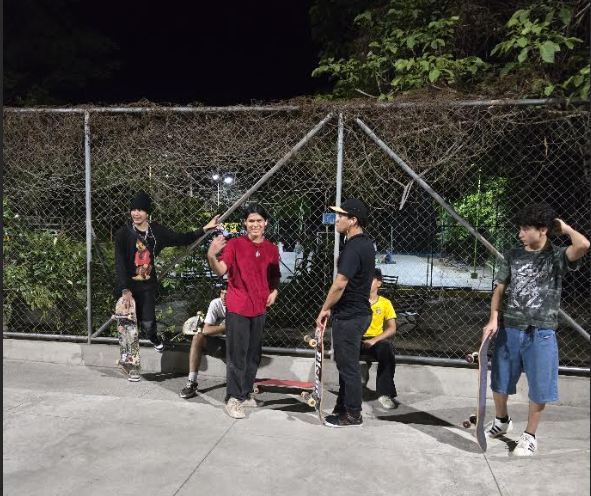
Friendships at the León skatepark. Before I could write their story, I first needed to listen.
Let every man be swift to hear, slow to speak, slow to wrath. — James 1:19 (KJV)
Once I recognized that the story for my third book had been in front of me all along, another realization quickly followed.
This story did not belong only to me.
The young men who helped create León’s skateboarding community had lived it. They had found ways to skate when equipment was difficult to obtain and safe places to practice were almost nonexistent. They had shared boards, built ramps, encouraged one another, and kept going when it would have been easier to quit.
I had been fortunate enough to become their friend.
But friendship did not automatically give me the right to tell their story however I pleased.
If I was going to write Ride the Fire, I needed to listen.
That sounds simple, but listening is different from merely hearing.
Hearing gathers facts.
Listening tries to understand what those facts meant to the people who experienced them.
I needed to learn more than where they skated or how they found their first boards. I needed to understand what drew them together, what obstacles they faced, and why the community they created mattered so deeply to them.
Their experiences would inspire the novel, but I did not want to take their lives and simply turn them into convenient pieces of fiction.
I wanted to honor them.
That meant asking questions.
It meant hearing different memories of the same years.
It meant recognizing that no single person sees an entire story.
And sometimes, it meant setting aside what I thought I understood so that someone else could tell me what I had missed.
“Let every man be swift to hear, slow to speak, slow to wrath.”
— James 1:19 (KJV)
We often think of this verse as guidance for avoiding arguments. And it certainly is.
But I believe it also teaches us something about understanding people.
We cannot truly know another person’s story if we are always preparing our own response.
We cannot learn what shaped someone if we decide in advance what their experience must have been.
And we cannot honor people well if we speak for them before we have taken the time to listen to them.
This lesson extends far beyond writing.
Every person we meet carries memories, struggles, hopes, and experiences we cannot see from the outside.
We may notice what they do without understanding why they do it.
We may see where they are today without knowing the road that brought them there.
We may even believe we know someone well while still knowing only a small part of their story.
Writing Ride the Fire reminded me that listening is one of the greatest gifts we can offer another person.
Not listening so that we can correct them.
Not listening while waiting for our turn to speak.
Simply listening because their story matters.
The book may have carried my name on the cover.
But the story behind it belonged to a community.
My responsibility was to listen closely enough to tell it with care.
