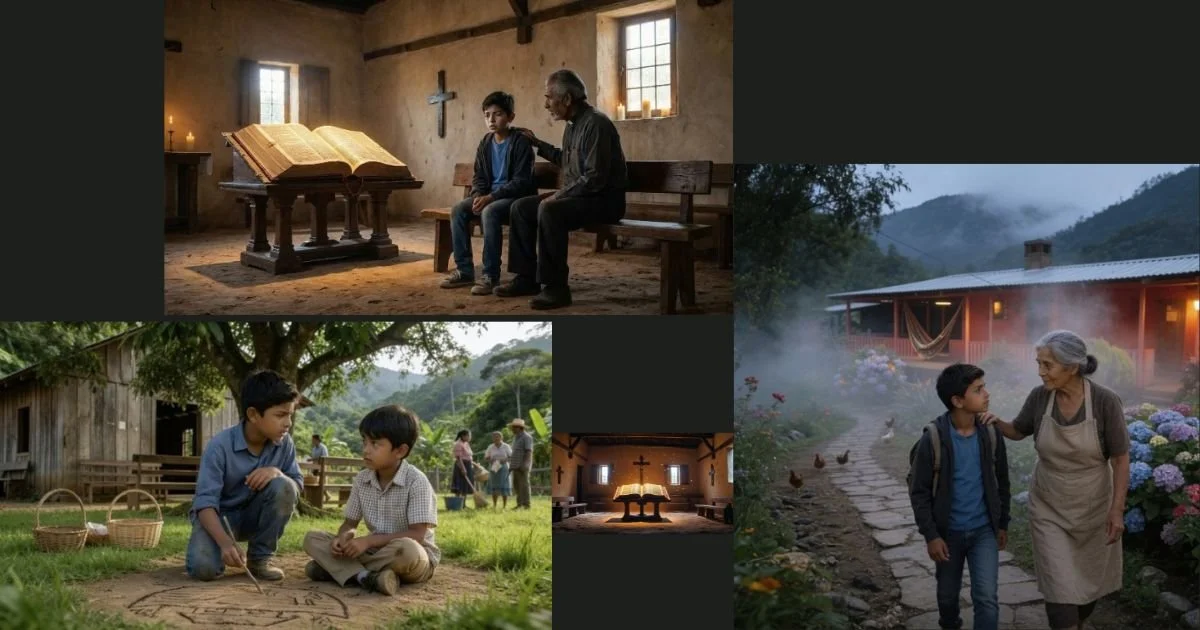
Verbum can take Mateo into Bible history. Father Tomás, Miguel, and Doña Rosa help him understand what he brings home.
Sending Mateo into Bible history was the easy part.
Bringing him home was harder.
When I first imagined Mateo and the Secrets of the Eternal Word, much of my attention was on the adventure.
A twelve-year-old boy living in the mountains of Nicaragua discovers an enormous ancient Bible called Verbum Aeternum.
Then the impossible happens.
The book takes him into the stories he has only read about.
Suddenly Mateo can stand in the Garden of Eden.
He can watch Noah build the Ark.
He can witness Cain and Abel.
He can see the Tower of Babel rising before him.
That gave me plenty of places to send him.
But eventually every journey ends.
Mateo comes home.
Then what?
How does a twelve-year-old boy make sense of what he has just witnessed?
Who does he tell?
Who would even believe him?
That's when I realized something important.
Mateo couldn't make this journey alone.
Father Tomás became one of the first people Mateo could turn to.
He listens.
He answers questions when he can.
And perhaps most importantly, Mateo gradually discovers that the old priest may understand Verbum Aeternum better than he first lets on.
Then there is Doña Rosa.
Grandmothers have a different way of looking at things.
She doesn't need to travel through time to have something worth saying.
Sometimes wisdom comes from experience, faith, and having lived long enough to recognize that a twelve-year-old boy doesn't always need an answer immediately.
Sometimes he simply needs someone who will listen.
Miguel has another role.
He is Mateo's friend.
He isn't a priest.
He isn't a grandmother.
He's another boy.
And that matters.
Because no matter how extraordinary Mateo's adventures become, I don't want him to stop being twelve years old.
He still needs a friend.
He still has a family.
He still lives in Miraflor.
There are chores to do, meals to eat, conversations around the house, and ordinary days between extraordinary journeys.
Those people keep Mateo connected to home.
And then there is Verbum.
At first, it would have been easy to treat Verbum Aeternum simply as the device that gets Mateo from one place to another.
Open the ancient Bible.
Travel into history.
Return home.
Repeat.
But somewhere along the way, Verbum became more than transportation.
He became part of the journey.
Verbum doesn't simply show Mateo things.
He challenges him.
Sometimes he answers.
Sometimes he doesn't.
And sometimes he leaves Mateo with a question that has to travel home with him.
That may be the most important reason Mateo doesn't travel alone.
The journey isn't really finished when he returns from Bible history.
In some ways, that's when it begins.
Seeing Cain and Abel is one thing.
Trying to understand what he witnessed is another.
Standing in Eden is extraordinary.
Wondering what Eden means for the world Mateo knows is something else entirely.
Noah's Ark can take Mateo into the past.
But the questions he brings home belong to the present.
And those questions give him reasons to sit with Father Tomás.
To listen to Doña Rosa.
To talk with Miguel.
To think.
To pray.
And eventually, to discover some answers for himself.
When I began writing Mateo's story, I thought the great adventure would be traveling into Bible history.
I'm beginning to think I was only partly right.
Verbum can show Mateo where the story happened.
The people who care about him can help him understand what it means.
Perhaps there's a lesson hidden there that reaches beyond Mateo.
We can see remarkable things.
We can travel extraordinary roads.
We can ask difficult questions.
But we were never meant to understand everything by ourselves.
Some journeys may begin alone.
But the important ones rarely stay that way.
