Who Is Doña Rosa?
When I began creating Mateo, I knew he couldn't exist by himself.
He needed a family.
He needed a home.
And somewhere in that home, I knew there needed to be a grandmother.
Her name became Doña Rosa.
At first, that was all she was meant to be.
Mateo's grandmother.
But characters don't always remain what you intended them to be.
Doña Rosa certainly didn't.
As Mateo and the Secrets of the Eternal Word began to take shape, I realized there was something different about her.
She knew things.
Or perhaps it would be more accurate to say—
she seemed to know things.
She Wasn't Surprised
Imagine being twelve years old and trying to explain that an ancient Bible hidden inside an abandoned mountain church had somehow carried you thousands of years into the past.
That you had seen the Garden of Eden.
That you had watched Noah build the ark.
That you had stood among the people of Babel.
Most grandmothers might have a few questions.
Doña Rosa does too.
But there is something unusual about hers.
She isn't shocked.
She doesn't dismiss Mateo's stories as dreams or a child's imagination.
Instead, she listens.
Carefully.
Sometimes she asks a question that helps Mateo understand something he hadn't understood himself.
And sometimes—
she says almost nothing at all.
That silence began to intrigue me.
Because eventually I found myself asking the same question I hope readers ask:
What does Doña Rosa know?
Was Mateo Really Chosen by Accident?
Mateo discovers the Verbum Aeternum in an abandoned church in the mountains of Miraflor.
At first, it appears that he simply stumbled upon something extraordinary.
But did he?
As the story develops, there are hints that Mateo's connection to the ancient Bible may not be an accident.
And somehow, Doña Rosa seems connected to that mystery.
She never sits Mateo down and explains everything.
She never says, I know why this is happening to you.
That would be much too easy.
Instead, she guides him.
She helps him think about what he has witnessed.
She seems to understand that Mateo isn't being sent into the past merely to see biblical history.
He is being sent there to learn from it.
And every once in a while, Doña Rosa says or does something that raises another question.
Does she know why Mateo was chosen?
Perhaps.
But if she does, she isn't telling him.
Not yet.
Finding Doña Rosa
Just as I had to discover what Mateo looked like, I had to discover Doña Rosa.
I knew she should look Nicaraguan.
But I wanted something else in her face.
Warmth, certainly.
Strength.
Wisdom.
But also something difficult to define.
The expression of someone who might know a secret—
and has decided that you aren't quite ready to hear it.
I went through different versions until eventually I looked at one and thought:
There she is.
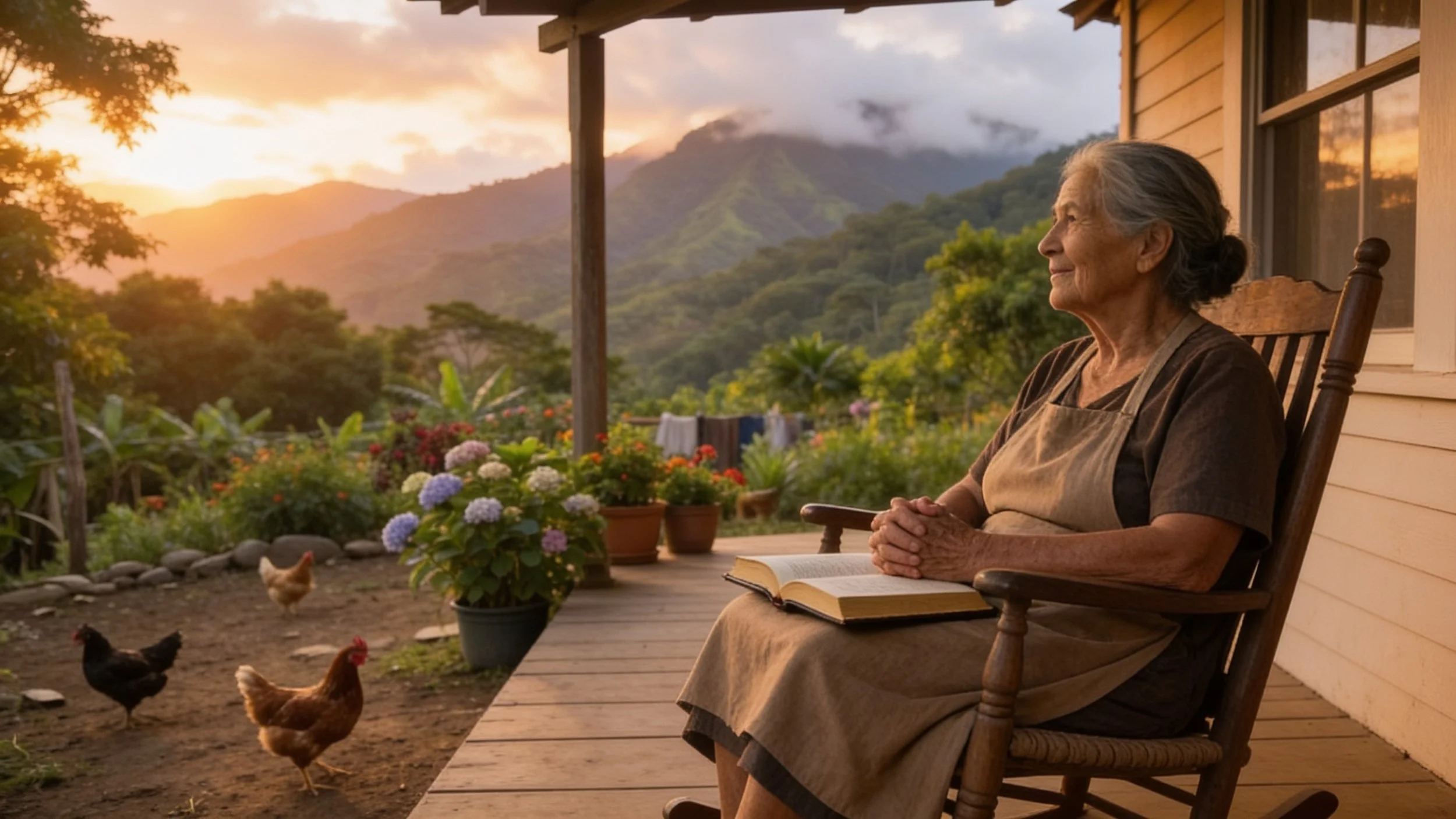
Doña Rosa on the porch in Miraflor—watching, listening, and perhaps knowing more than she says.
Doña Rosa.
Doña Rosa watches over Mateo with the quiet wisdom of someone who may understand far more than she reveals.
The Person Mateo Comes Home To
Mateo's journeys take him into some of the greatest stories ever told.
Creation.
The Flood.
Babel.
And now, as his journey continues, Abraham.
But eventually Mateo always comes home.
Back to Nicaragua.
Back to Miraflor.
Back to Doña Rosa.
And that may be more important than it first appears.
Because Doña Rosa doesn't simply comfort Mateo after his journeys.
She helps him understand why they matter.
She listens to what he saw.
She notices what he missed.
She occasionally nudges him toward questions he hasn't thought to ask.
And all the while, one larger question remains unanswered.
Mateo may be traveling through the Verbum Aeternum.
But Doña Rosa seems to know something about the journey that Mateo doesn't.
Perhaps even something about why it is Mateo making the journey in the first place.
For now, she isn't telling.
And I think we'll let her keep her secret a little longer.
