What Happens When the Book Leaves Your Hands?
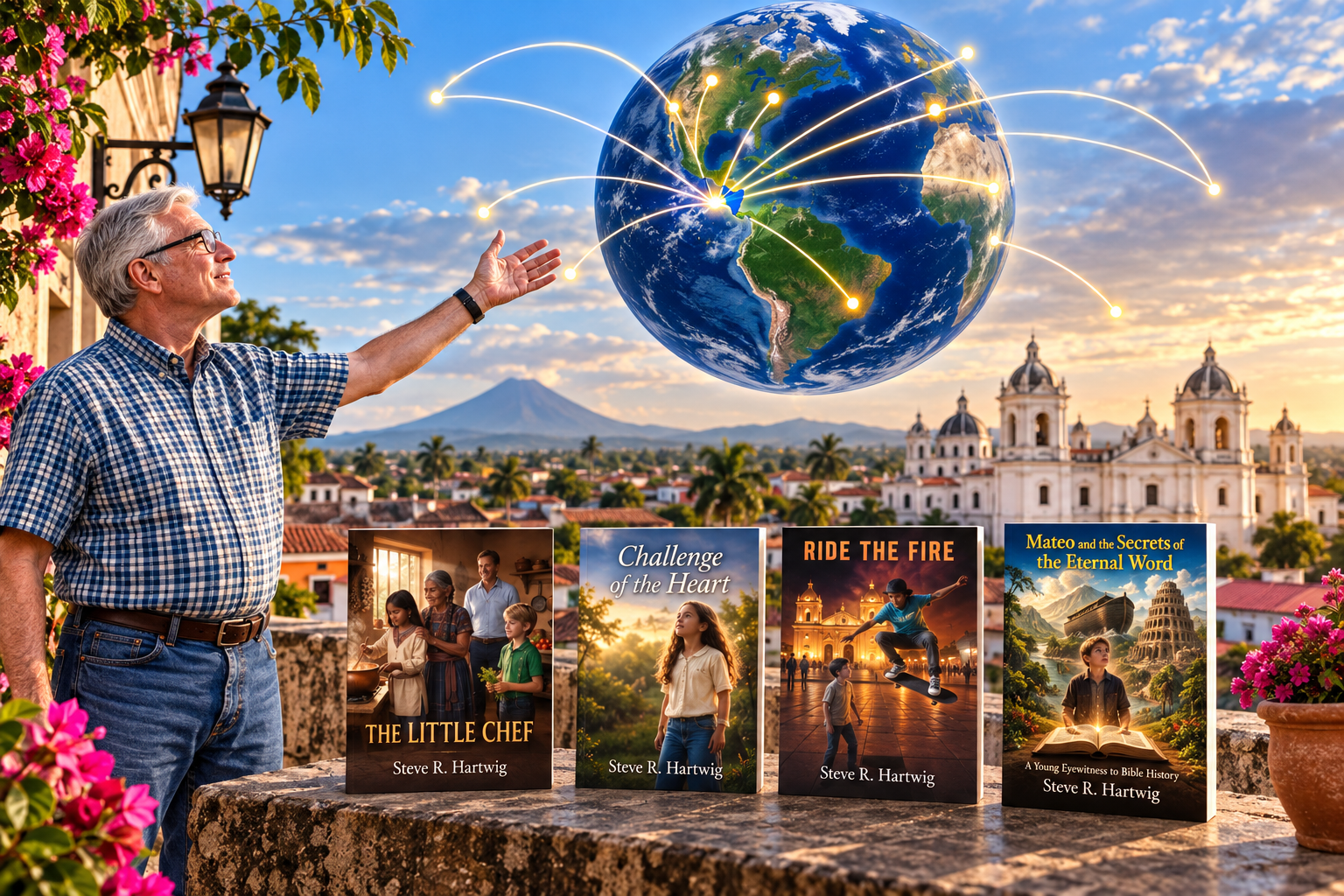
Four stories began in Nicaragua. Once they left the author's hands, there was no telling how far they might travel.
Commit thy works unto the LORD, and thy thoughts shall be established.
— Proverbs 16:3 KJV
There is a strange moment in the life of a book.
For months—or sometimes years—it belongs almost entirely to the author.
You decide what happens. You choose the characters. You write scenes no one else has ever seen. You change a word, rewrite a paragraph, move a chapter, and sometimes wonder whether any of it is working.
The characters live mostly in your imagination.
The story lives on your computer.
And then one day you press Publish.
Something changes.
The story leaves your hands.
When Someone Else Meets Your Characters
I experienced that for the first time with The Little Chef.
Then again with Challenge of the Heart.
Later came Ride the Fire.
And most recently, Mateo and the Secrets of the Eternal Word.
Each time, there was a moment when something I had created privately became something other people could read.
At first, I suppose I was mostly wondering whether they would read it.
A couple of weeks ago, I wrote about that question:
Would anyone read my books?
The answer turned out to be yes.
There were Amazon reviews. There were professional reviews. There were comments from readers. Other authors read my work and told me what they thought.
And something interesting began to happen.
People started telling me things about my own books.
Seeing the Story Through Someone Else's Eyes
A reviewer might mention a quality in Mateo that particularly stood out.
Someone else might talk about the importance of family in the story.
Another reader might focus on the faith.
Still another might be fascinated by Nicaragua or the biblical history.
I wrote all of those things.
But I didn't necessarily know which one would matter most to someone else.
That's one of the things I'm learning about being an author.
Once someone reads your story, it becomes part of their imagination too.
They meet Mateo for themselves.
They form their own picture of Doña Rosa.
They decide how they feel about Father Tomás.
They wonder what Verbum Aeternum really is.
And sometimes they see something in the story that even the author hadn't stopped to consider.
The words are still mine.
But the experience of reading them belongs to the reader.
Then the Books Started Traveling
Last Monday, I wrote about another discovery.
After wondering whether anyone could find my books, I did something very sophisticated.
I Googled myself. 😊
Then I Googled Mateo.
That was when things became interesting.
I found Mateo and the Secrets of the Eternal Word in places where I had never personally put it.
Walmart.
ThriftBooks.
Amazon sites in different countries.
Booksellers in Italy and Denmark.
And then I discovered Mateo sitting at #6 on an Amazon Hot New Releases list, with the Spanish edition at #13.
Suddenly, that little boy from the mountains of Nicaragua seemed to be traveling quite nicely without me.
But afterward, I began thinking about what that really meant.
I Can't Follow Everywhere They Go
When I wrote Ride the Fire, the story was right here with me in León, Nicaragua.
When I created Mateo, he began in my imagination and found his home in the mountains of Miraflor.
I knew exactly where those stories were.
They were with me.
That's no longer true.
A book can be sitting on someone's shelf thousands of miles away.
Someone I will never meet may be reading one tonight.
A parent may hand Mateo to a child.
A reader may recommend Ride the Fire to a friend.
Someone may discover one of the books through a Google search, a bookseller, a social media post, or perhaps simply by accident.
I'll never know about most of those moments.
And perhaps I'm not supposed to.
Letting Go
There is a lesson in that which goes beyond writing books.
We like to know what will happen with the things we create.
We like to see results.
We like to know that the work mattered.
But faith doesn't always give us that privilege.
Sometimes we're simply asked to do the work placed before us and then entrust the result to God.
That's why the words of Proverbs seem especially appropriate to me now:
“Commit thy works unto the LORD, and thy thoughts shall be established.”
I can write the story.
I can rewrite it until I'm satisfied.
I can publish it.
I can tell people about it.
I can even Google it occasionally to see where it wandered off to. 😊
But eventually, I have to let it go.
The Story Leaves Your Hands
Last week I went looking for Mateo to see where in the world he had gone.
Maybe I was asking the wrong question.
Perhaps an author's job isn't to know everywhere his story will go.
His job is to write it, polish it, send it on its way—and trust God with what happens next.
Four times now, I've taken something that existed only in my imagination and released it into the world.
I don't know everyone who has read those stories.
I don't know where all the copies are.
And I certainly don't know where they may travel next.
But perhaps that's part of the adventure too.
I know where The Little Chef began.
I know where Challenge of the Heart began.
I know where Ride the Fire began.
And I definitely know where Mateo began.
I'm becoming increasingly curious about where they'll all end up. 😊
