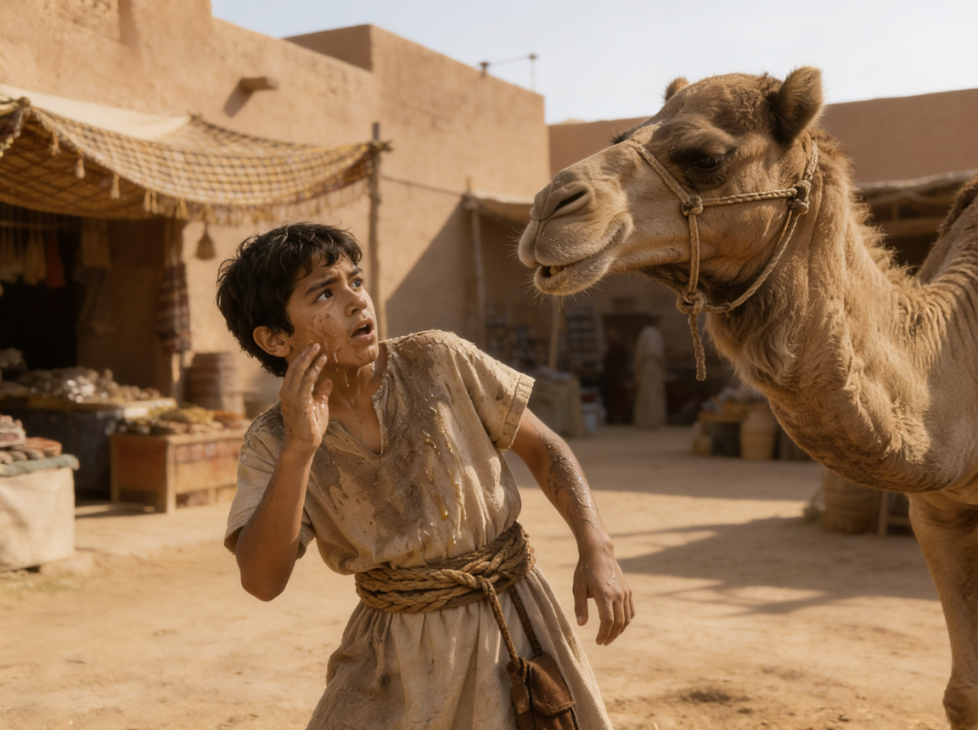
When I began writing about Abraham's caravan, I knew Mateo would need a purpose—a position in the caravan. He needed a reason to be there.
My research revealed that there were many possible jobs for Mateo, but I thought that since he lived on a farm in Miraflor, he would be best suited to working with animals.
He was accustomed to caring for cows, oxen, and chickens.
Camels would be a challenge.
Especially one camel in particular.
His name was Jamil.
I knew that a large caravan like Abraham's would require a great deal of work. Animals needed to be fed and watered. Loads had to be secured. Supplies needed to be organized. And everyone had a responsibility.
Mateo couldn't simply walk alongside Abraham, asking questions and watching history unfold.
He needed to become part of the daily life of the caravan.
So I made him a camel groom.
Of course, Mateo had never worked with camels before. But he understood animals, and I thought that would give him a good beginning.
He just needed someone to teach him.
That's where Suri came into the story.
Suri was an experienced camel handler, familiar with the animals and the routines of caravan life. He would become Mateo's teacher and, eventually, his friend.
I liked the idea of Mateo learning from someone who had spent years doing work that most of us know very little about.
And then there was Jamil.
Jamil belonged to Sarai, Abraham's wife. He was an important animal in the caravan, and apparently, he knew it.
I hadn't intended to give Jamil such a prominent role.
But as I imagined Mateo's first experiences with the camels, I realized that everything shouldn't go smoothly.
After all, Mateo was a farm boy from Nicaragua who had suddenly found himself caring for animals he had never seen up close.
Surely there would be a few surprises.
And Jamil was quite willing to provide one.
Mateo approached him with the confidence of a boy who knew how to handle animals.
Jamil had other ideas.
What followed involved a rather unpleasant mouthful of green camel spit.
And Mateo was on the receiving end.
I confess that I enjoyed writing that scene.
Not because I wanted Mateo to suffer, of course.
But because I could imagine his expression.
Here was a boy who had traveled through the pages of an ancient Bible, witnessed extraordinary events, and found himself among the people of Genesis.
And now he was standing in Abraham's caravan, covered in camel spit.
Sometimes the extraordinary and the ridiculous can happen on the very same day.
That little incident also helped me accomplish something important.
It reminded me that the people of the Bible lived ordinary lives.
They worked. They cared for animals. They prepared meals. They grew tired. They laughed. And I suspect they occasionally had disagreements with stubborn camels.
The events recorded in Scripture are extraordinary, but the people who experienced them lived in a very real world.
I wanted Mateo to experience that world, not merely observe it.
And I wanted readers to feel that they were there with him.
Suri would teach Mateo the responsibilities of his new position. Over time, Mateo would become more comfortable with the camels and the routines of the caravan.
But I suspect he would always keep a watchful eye on Jamil.
One of the pleasures I've discovered in writing fiction is that a character doesn't have to be central to the story to become memorable.
Sometimes a supporting character brings warmth or friendship.
Sometimes an animal brings humor.
And sometimes a camel decides that the new boy needs a lesson in humility.
When I began Book Two, I knew Abraham would be an important part of Mateo's journey.
I knew there would be great events to witness and important lessons to learn.
What I didn't know was that a camel named Jamil would become one of my favorite characters to write.
Apparently, Jamil had plans of his own.
And Mateo was about to discover them the hard way.
